

445 Ferry Street San Pedro, CA 90731 United States
What to know
- TIRE is the nation's first full-scale deep well injection program that converts wastewater residuals (biosolids) into clean renewable energy deep underground.
- The program processes 100% of biosolids from Terminal Island Water Reclamation Plant (TIWRP) and 20% from Hyperion Treatment Plant, handling 65,000 tons of bio-slurry every year.
- Diverts over 840,000 dry tons of biosolids from land application and eliminates over 4.2 million miles of heavy truck traffic outside the Los Angeles Basin.
- Injects bio-slurry more than one mile underground (5,300 to 7,500 feet)—far beneath drinking water aquifers—protected by triple concrete-and-steel barriers and monitored 24/7.
- Recognized nationally by the United States Environmental Protection Agency (US EPA), National League of Cities (NLC), and Harvard Kennedy School for technical innovation and environmental stewardship.
Program Overview
LA Sanitation and Environment (LASAN) protects public health and local waterways by converting municipal wastewater residuals into clean renewable energy through the Terminal Island Renewable Energy (TIRE) program. Operating at the Terminal Island Water Reclamation Plant (TIWRP) in the City of Los Angeles, TIRE is the nation's first full-scale application of deep well injection and geothermal biodegradation.
By placing biosolids into depleted oil and gas formations more than a mile underground, LASAN eliminates heavy truck hauling, reduces air pollution, and sequesters carbon dioxide ($CO_2$). The TIRE program manages 100% of TIWRP’s biosolids and 20% of residuals from the Hyperion Treatment Plant, injecting 65,000 tons of bio-slurry annually. LASAN leads this innovative initiative in partnership with GeoEnvironment Technologies, Advantek Waste Management Services, Vaulted Deep, and the United States Environmental Protection Agency (US EPA), with founding support from the United States Department of Energy (DOE) and the National Science Foundation (NSF).
Deep Well Science
TIRE uses natural geothermal heat and deep geologic pressure to transform municipal bio-slurry (a mixture of treated wastewater residual solids, brine, and effluent) into clean energy.
- Injection Zone: Bio-slurry is injected through high-pressure wells into porous rock formations located 5,300 to 7,500 feet below the surface.
- High-Temperature Biodegradation: At temperatures between 114°F and 159°F (45°C to 70°C), natural high-temperature anaerobic biodegradation sterilizes the material within 24 hours.
- Energy Generation & Carbon Storage: Over a 30 to 60-day period, deep earth organisms convert organic matter into methane, carbon dioxide, and inert solids. Carbon dioxide dissolves permanently in subsurface formation brine, while pure methane is trapped in natural reservoirs for future recovery as renewable energy.
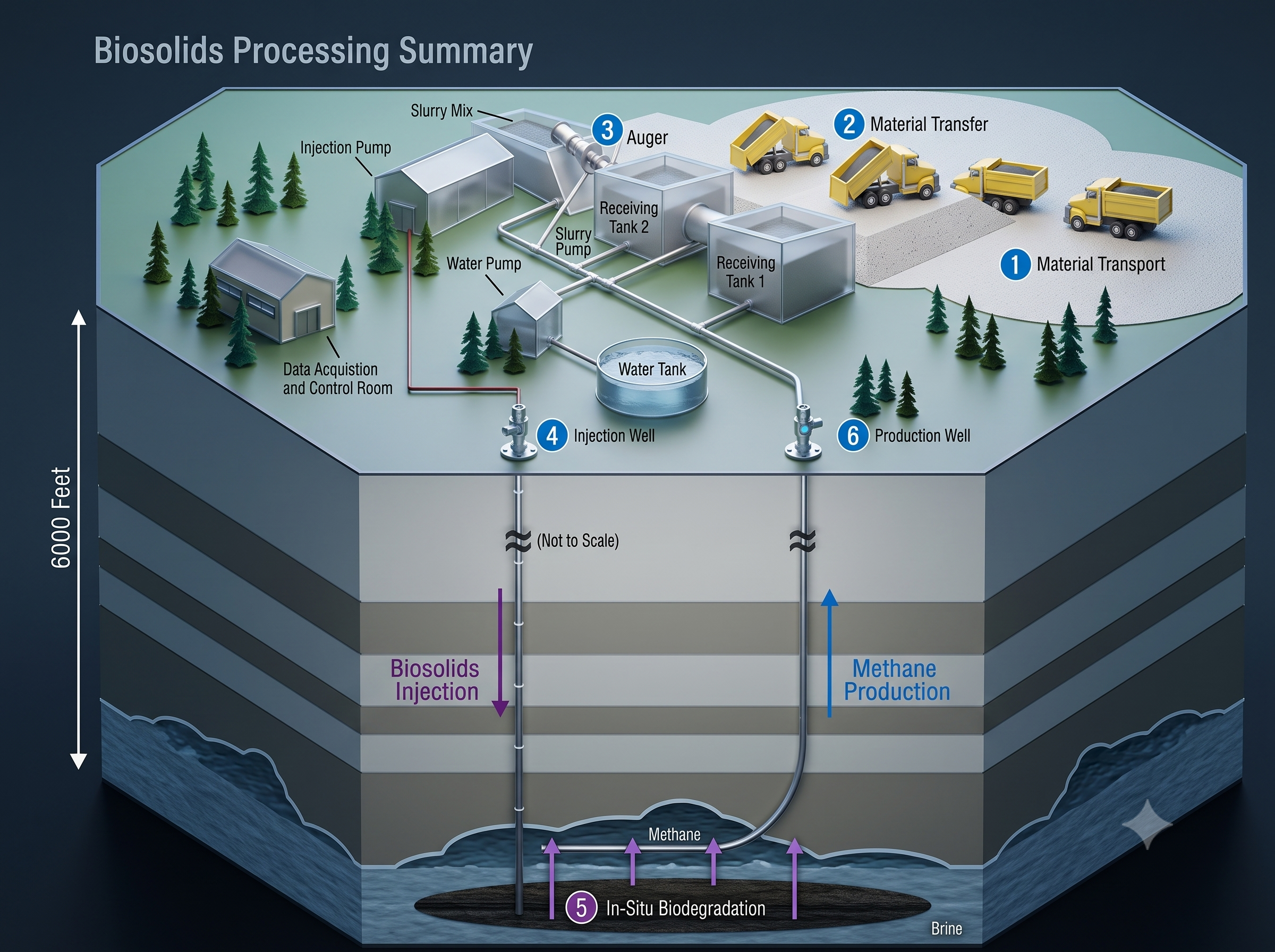
The 3D cross section diagram below shows the 6-step biosolids processing cycle, from surface transport and slurry mixing to deep underground injection (at 6,000 feet), in-situ biodegradation, and methane extraction through a production well.

This next cross-section diagram, below, illustrates wellhead protection measures, including triple concrete and steel barriers, 24/7 pressurized annulus monitoring, impermeable rock layers, and deep injection into a target zone over 1 mile underground.

Both diagrams can be enlarged for easier viewing in our Photo Gallery at the bottom of this page.
Environmental Impact
By managing biosolids locally within City-owned facilities, TIRE dramatically cuts greenhouse gas (GHG) emissions and protects air and water quality across Southern California.
- Air Quality & Reduced Emissions: Eliminates long-distance truck trips to inland agricultural disposal sites, avoiding over 5,735 metric tons of direct carbon dioxide ($CO_2$) emissions and over 4.6 million metric tons of carbon dioxide equivalent ($MTCO_2e$) in cumulative greenhouse gases over 20 years.
- Traffic & Noise Reduction: Removes approximately 4,221,370 miles of heavy truck traffic from Los Angeles roadways, reducing diesel exhaust, dust, and street wear.
- Harbor Protection: Decreases brine and effluent discharges into the Port of Los Angeles, improving marine water quality in the LA Harbor.
- Land & Groundwater Preservation: Diverts over 840,000 dry tons and 550,000 wet tons of biosolids from surface land application, preserving regional groundwater safety.
Safety Safeguards
Protecting public health and Los Angeles drinking water resources is the top priority of the TIRE program. Deep well operations strictly comply with the US EPA Underground Injection Control (UIC) Class V permit standards.
- Drinking Water Protection: Wellheads feature triple-concentric barriers of heavy steel casing and protective concrete that isolate injection flows from freshwater aquifers.
- 24/7 Leak Detection: A pressurized fluid annulus is continuously monitored 24 hours a day to detect pressure changes and prevent leaks instantly.
- Geologic Containment: Multiple layers of dense, impermeable rock and shale several hundred feet thick prevent upward migration of fluids or gases.
- Advanced Monitoring: Subsurface stability and safety are tracked in real time using geophones, tiltmeters, gamma-ray sensors, densitometers, microseismograms, and lab fluid analysis. Operations produce zero surface odor or noise complaints.
TIRE Program Environmental Outcomes
Air Quality & GHG Reduction
Avoided 4,628,639 $MTCO_2e$ in cumulative greenhouse gases over 20 years.
Truck Traffic Elimination
Eliminated 4,221,370 miles of heavy diesel truck transportation outside LA Basin.
Land Application Diversion
Diverted 840,000+ dry tons and 550,000+ wet tons of biosolids from surface land disposal.
Harbor Water Protection
Reduced brine and effluent discharge volume into the Port of Los Angeles.
Local Resource Ownership
Processes 100% of TIWRP and 20% of Hyperion biosolids at City-owned facilities.
Program Timeline and History
- November 2006: US EPA issues the initial 5-year Class V permit.
- April 2007: Groundbreaking ceremony held at TIWRP.
- July 2008: Slurry fracture injection operations officially begin.
- December 2013: Second 5-year US EPA permit approved; operations scale up to process 100% of TIWRP biosolids
- September 2017: TIRE expands capacity to receive 20% of biosolids from Hyperion Treatment Plant.
- July 2022: US EPA renews TIRE's 10-year Underground Injection Control (UIC) permit, establishing deep well injection as a permanent, safe endpoint for biosolids.
- October 2024: Regulatory approval granted to expand well depths from 5,300 feet down to 7,500 feet, increasing geothermal biodegradation capacity up to 400 tons per day.
Awards and Recognition
- 2011: National Association of Clean Water Agencies (NACWA) – National Environmental Achievement Award for Research and Technology
- 2011: Water Environment Research Foundation (WERF) – Excellence in Innovation Award
- 2010: National League of Cities (NLC) – Award for Municipal Excellence (Silver Award)
- 2010: California Association of Sanitation Agencies (CASA) – Technical Innovation and Achievement Award
- 2009: Harvard Kennedy School Ash Institute – Top 50 Finalist in Innovations in American Government Award
- 2009: California Water Environment Association (CWEA) LA Basin Section – Plant of the Year
- 2009: United States Department of Energy – TIRE Innovation Grant
- 2008: National Association of Clean Water Agencies (NACWA) – National Environmental Achievement Award for Public Information and Education
Gallery: 3D Diagrams (click photo to enlarge)

Frequently Asked Questions
Does deep well injection pose any risk to Los Angeles drinking water?
No. Injection takes place more than one mile underground (5,300 to 7,500 feet), deep beneath local drinking water aquifers. Well shafts feature triple layers of steel and concrete, and impermeable rock layers prevent upward movement. Operations are monitored 24/7 under US EPA permits.
What happens to the gases generated underground during geothermal biodegradation?
Carbon dioxide dissolves naturally into deep subterranean brine reservoirs. Methane gas remains safely trapped in deep geological structures, where it can be collected and harnessed as clean, renewable energy.
Related programs

Biosolids Management Program

Watershed Protection
Related facilities

Terminal Island Water Reclamation Plant

Hyperion Water Reclamation Plant